Jump to section
An introduction to music for meditation
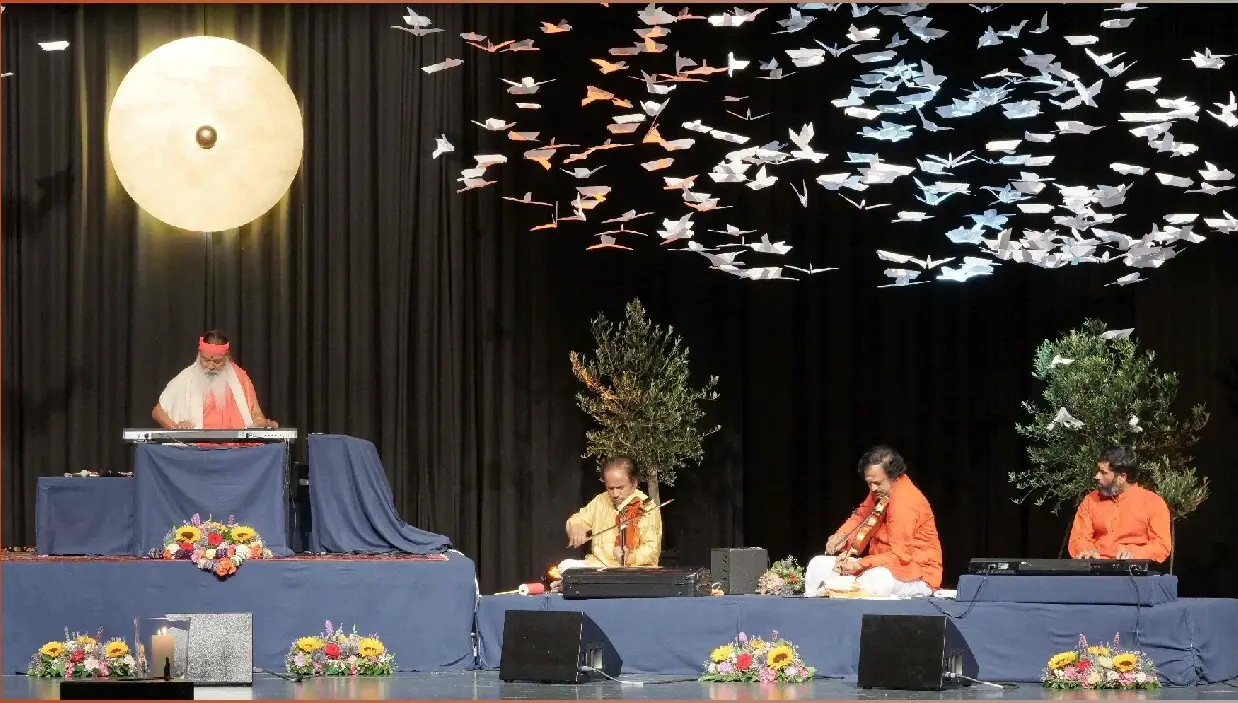
Sri Ganapathy Sachchidananda Swamiji performs music that draws on the Indian classical tradition and shapes it for an experience of meditation. He plays a synthesiser programmed with over a thousand sounds he has personally selected across decades, accompanied by an ensemble of master musicians on violin, flute, mridangam, and tabla.
The format moves between two registers. There are passages of solo improvisation, where the synthesiser carries the melody and atmosphere alone. There are ensemble passages where the rhythm instruments carry on a vivid conversation with the melodic line. The result is a listening experience that is at once contemplative and alive.
Indian classical music rests on two systems: raga (the melody) and tala (the rhythm). The sections below introduce each in turn, alongside the small but significant idea of shruti, the way Indian music divides the octave more finely than Western music does.
Sri Swamiji, the artist
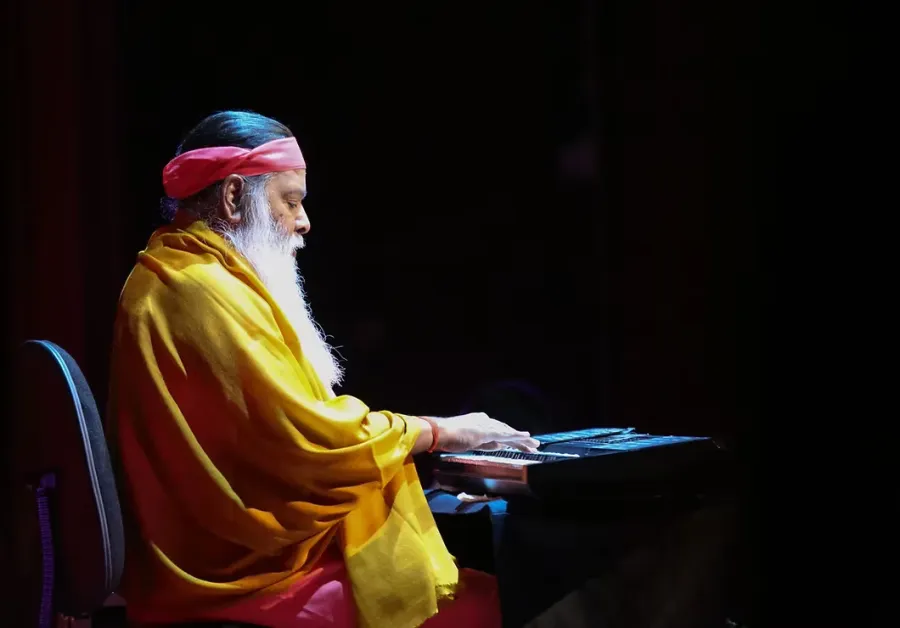
Sri Ganapathy Sachchidananda Swamiji was born on 26 May 1942 in southern India, in a household where Vedic chanting and music were a daily practice. He learned from his mother, the yogini Mata Jayalakshmi, until her passing in 1951, and continued his rigorous yogic training under his paternal aunt Venkamma, a hatha yoga master.
In 1966, at the age of twenty-four, he founded the ashram in Mysuru that remains his home base today. What began as a small hut on ten acres now includes a music hall, a recording studio, a Vedic school, a museum, and one of the largest bird sanctuaries in India. His decades-long research into ragas and Nada Yoga has been recognised with four honorary doctorates, most recently a 2026 doctorate in Nada Yoga from Vedic Wellness University (Florida), conferred together with the title “Nada Yoga Sarvabhauma”.
His musical lineage traces back to Govinda Dikshitar and his son Venkatamakhin, the seventeenth-century theorist who codified the 72-melakarta system that organises Carnatic music to this day.
He performs on a synthesiser programmed with over a thousand sounds he has personally selected across decades, accompanied by an ensemble of master musicians. He has released more than 200 albums of instrumental music, devotional songs, and Sanskrit chant in nine languages. He has authored dozens of books, the proceeds of which are donated to charitable causes.
His first international concert took place on 24 July 1987 in the Grand Ballroom of Hotel Krasnapolsky in Amsterdam. The concert came about by accident. After a small synthesiser was given to him during a stay in Vijayawada in the mid-1980s, a Dutch devotee who heard him play asked permission to organise a programme in the Netherlands. That evening became the first of what is now 377 concerts across 33 countries.
He holds thirteen Guinness World Records, including the largest music therapy lesson (Sydney Opera House, 2015, with 1,814 participants), the largest mass chant (128,918 participants), the largest bonsai display (2,649 trees), and an aviary of 468 bird species.
He has put it in three words: music is my religion.
Raga: the melody
A raga is more than a scale. It is a melodic framework with a particular mood, a set of permitted notes, an ascending pattern and a descending pattern, and a set of small phrases that give the raga its character. The Carnatic system is built on 72 melakarta ragas, the parent scales from which the others derive, and each carries its own emotional weather: morning, evening, longing, joy, devotion, calm.
A musician improvising within a raga is something like a poet writing within the constraints of a chosen verse form. The raga sets the rules; the musician brings the breath. No two performances of the same raga ever sound the same.
In Sri Swamiji’s concerts, the choice of raga shapes the entire mood of a piece. A slow evening raga settles the room; a brighter raga lifts it. The synthesiser’s voice changes with each raga, drawing on its programmed library of sounds to find the one that fits.
A selection of Carnatic ragas, rendered as simple sine and triangle tones over a tanpura-like drone (Sa + Pa, A = 220 Hz). Intended to illustrate the arohana, without the gamakas and bhava of a live performance.
Shruti: the 22 microtones
Most Western listeners know the octave as twelve equal steps, the white and black keys of a piano. Indian classical music divides the same octave more finely, into twenty-two intervals called shrutis. The extra steps are not used as a separate scale; they live inside the spaces between the twelve familiar notes, giving Indian music its particular shading and emotional range.
In practice, shrutis are heard most clearly in the small slides and inflections between notes that mark Indian classical phrasing. They are the reason a melody played on an Indian violin or a synthesiser following an Indian raga sounds different from the same notes on a piano: not because the notes are exotic, but because the spaces between them are doing more work.
Hover a point or click to hear the tone. The uneven spacing reveals the microtonal refinement.
Tonic referenced to A = 220 Hz. Pure sine tones for reference purposes.
Tala: the rhythm
Tala is the rhythmic structure of Indian classical music. It is more than a metronome. It is a cycle, a pattern of beats and silences, that the musician returns to over and over, often in dialogue with the melody.
Two percussion instruments anchor the ensemble. The mridangam is the principal percussion of the south, an ancient double-headed barrel drum played with the hands. The tabla is the principal percussion of the north, a pair of small tuned drums played with the fingers and palms. In a concert, the two often hold a long conversation with each other, sometimes following the melody, sometimes deliberately complicating it. Listeners new to Indian classical music often find the rhythmic exchange the most surprising part of the experience: it sounds improvised because much of it is, but it always finds its way home to the cycle.
The ensemble
Sri Swamiji performs with the Celestial Message Troupe, an ensemble of master musicians who have toured with him for more than two decades. Current members include the synthesiser (Sri Swamiji), Shankar Ramesh on mridangam (from Mysuru, a senior disciple of Karaikudi Mani), Jaitra Varanasi on violin (from Guntur, a graduate of Sri Venkateshwara University), and Mani Tadepalli on keyboard accompaniment (from Machilipatnam).
The ensemble’s role is not background accompaniment. Each musician carries a melodic or rhythmic voice in dialogue with Sri Swamiji’s synthesiser, and the dialogue is the music. Many of India’s most celebrated classical musicians, including Pandit Hari Prasad Chaurasia, Pandit Vishwa Mohan Bhatt, the late Pandit Jasraj, the late Ustad Zakir Hussain, the late S. P. Balasubrahmanyam, and Dr. L. Subramaniam, have performed Sri Swamiji’s compositions or shared the stage with him.
Collaborating musicians
Across four decades, many of India’s most celebrated classical musicians have performed Sri Swamiji’s compositions or shared the stage with him. A short list of those whose names will be familiar to listeners of Indian classical music: Pandit Hari Prasad Chaurasia (flute), Pandit Vishwa Mohan Bhatt (Mohan veena), Pandit Jasraj (vocal, 1930–2020), Ustad Zakir Hussain (tabla, 1951–2024), S. P. Balasubrahmanyam (vocal, 1946–2020), Dr. L. Subramaniam (violin, Padma Vibhushan 2025), Mysore Chandan Kumar (flute), Kadri Gopalnath (saxophone, 1949–2019), Sudha Raghunathan (vocal), T. M. Krishna (vocal), and Karaikudi Mani (mridangam, 1945–2023).
A fuller list of collaborating artists is available in the press kit.
Sound, healing, and the music of the spheres
Indian classical music carries a long-standing belief that sound itself is therapeutic, that particular ragas affect particular states of body and mind, and that music is a practice of healing as much as of art. Sri Swamiji’s concerts are sometimes described as music therapy sessions for this reason. In 2015, the Sydney Opera House hosted what Guinness World Records confirms as the largest music therapy lesson ever conducted, with 1,814 participants gathered around a single performance.
The idea is not exclusively Indian. The ancient Greek philosopher Pythagoras taught that the universe itself was built on numerical harmony, and that music had the power to balance the body and order the soul. He spoke of the music of the spheres, the inaudible music of the planets in their orbits. Indian and Greek musical philosophies, separated by a continent, arrive at a common intuition: sound is more than entertainment. It is structure, and the structure can heal.
This belief shapes how Sri Swamiji’s concerts are designed. They are not built for applause between movements; they are built for an extended, attentive presence. The visitor is invited to sit, to listen, and to allow the music to do its work.
Nada Chikitsa: music as medicine
The tradition has a name for what the previous section describes. Nada Chikitsa, literally, sound therapy, is the Indian practice of treating music as a form of medicine. It rests on an older idea, Nada Brahma: that creation itself is sound, and that the body, made of the same vibration as the world, can be tuned by it.
In the older theory, known as Raga Ragini Vidya, the 72 melakarta ragas of the Carnatic system are mapped to 72 nerve centres in the body, each raga capable of reaching its corresponding centre. The seven notes themselves, Sa, Ri, Ga, Ma, Pa, Da, Ni, are read symbolically as a journey: water, land, the flight of birds, the emergence of human life, divinity, dharma, and liberation. A scale, in this reading, is also a map.
Because the body is composed of the same five elements as the world, earth, water, fire, air, and ether, the practice uses physical objects as focusing points during a session: water held in the hand, a crystal, a mudra, a small flame. They are not the medicine; they are the way the listener’s attention is gathered so the music can reach more deeply. This is why, at some of Sri Swamiji’s concerts, listeners are invited to drink a small glass of water at the end.
Contemporary neuroscience describes much of this in its own vocabulary: alpha and theta brainwaves in attentive listening, a parasympathetic shift that lowers heart rate and cortisol, and a music-engaged network that reaches emotion and memory directly, without passing through verbal reasoning. For a short, sourced overview, see Music and the brain: what listening does.
The art of listening
Indian classical music has a name for the listener’s role: Nadopasana, the practice of attentive listening. The listener is not a passive recipient. The listener is part of the performance, the third instrument alongside the melody and the rhythm. A concert in this tradition is a shared act of attention.
This is part of why Sri Swamiji’s concerts can feel different from a standard recital. The audience is invited to settle into the music in a quieter, more inward way than at a typical classical concert. Many listeners describe the experience as meditation; some describe it as musical theatre; some describe it as something they have not previously had a name for. All of those descriptions are correct.
Further reading
- Sri Ganapathy Sachchidananda Swamiji, Music Heals the Healer Too
- Jaitra Varanasi, Sri Ganapathy Sachchidananda Swamiji’s music: a bird’s eye view
- Rudrapatna Shankar Ramesh, Rhythms in Healing Music
- Editorial, Music and the brain: what listening does
A library of essays on Sri Swamiji’s music, Nada Chikitsa, and the Carnatic tradition. Opens in a new tab.
- Raga Ragini Nada Yoga, an encyclopedia of healing music therapy
- Dr. Padma Murthy, Nada: music of the divine, and Raga–Ragini Nada Yoga in historical perspective
- Dr. T. V. Sairam, Nada Yoga: the meeting point of yoga, music and medicine
- Yogini Kaliji, Divine Music, Divine Yoga: Nada Chikitsa and Yoga Sadhana
- Ragas: the Melakarta system